This lesson introduces the multidimensional nature of media enjoyment. It demonstrates how neurometric tools, such as GSR, can capture affective responses while being complemented by cognitive and behavioral measures, providing filmmakers with a richer basis for creative and study design decisions.
Understanding media enjoyment is essential for applying neurometrics meaningfully in film production, as it links measurable physiological signals with the broader audience experience. Media enjoyment can be understood as the interaction of affective, cognitive, and behavioural dimensions. Affective responses dominate during viewing and can be tracked with signals such as the Galvanic Skin Response (GSR), an autonomic measure of fluctuations in skin conductance that reflects emotional arousal. Cognitive judgements consolidate afterwards and are best assessed through questionnaires, while behavioural factors capture prior experiences and actions during reception. Excitation transfer theory explains how arousal from one scene can carry over into another, amplifying emotional impact. Taken together, these perspectives show how neurometric measures like GSR can inform study designs and guide production decisions on pacing, editing, sound, and other creative elements.
Theory of Media-Enjoyment
As an Autonomic Nervous System Indicator, GSR measures fluctuations in the skin’s conductance that occur in response to heightened emotional states or general emotional excitation. Historically, excitation has been associated with stress and suspense in particular [1], but the applications of GSR are not limited to one specific emotional state or media genre. To better understand both the potentials and limitations of Neurometrics in supporting film production, the following section introduces a multidimensional theory of media enjoyment.
Media enjoyment, such as the joy derived from watching a movie, is a multidimensional phenomenon. Consider, for instance, attending a cinema screening of a favourite movie while surrounded by a disruptive and inattentive audience. Although the film itself may still be as appealing as ever on a cognitive level, the immediate enjoyment of the screening would be diminished. Conversely, a flashy horror film might effectively create a high level of physiological excitation while being intellectually underwhelming at the same time. In summary, media-enjoyment is too complex of a phenomenon to be defined by cognitive evaluation or emotional affect only [2:290].
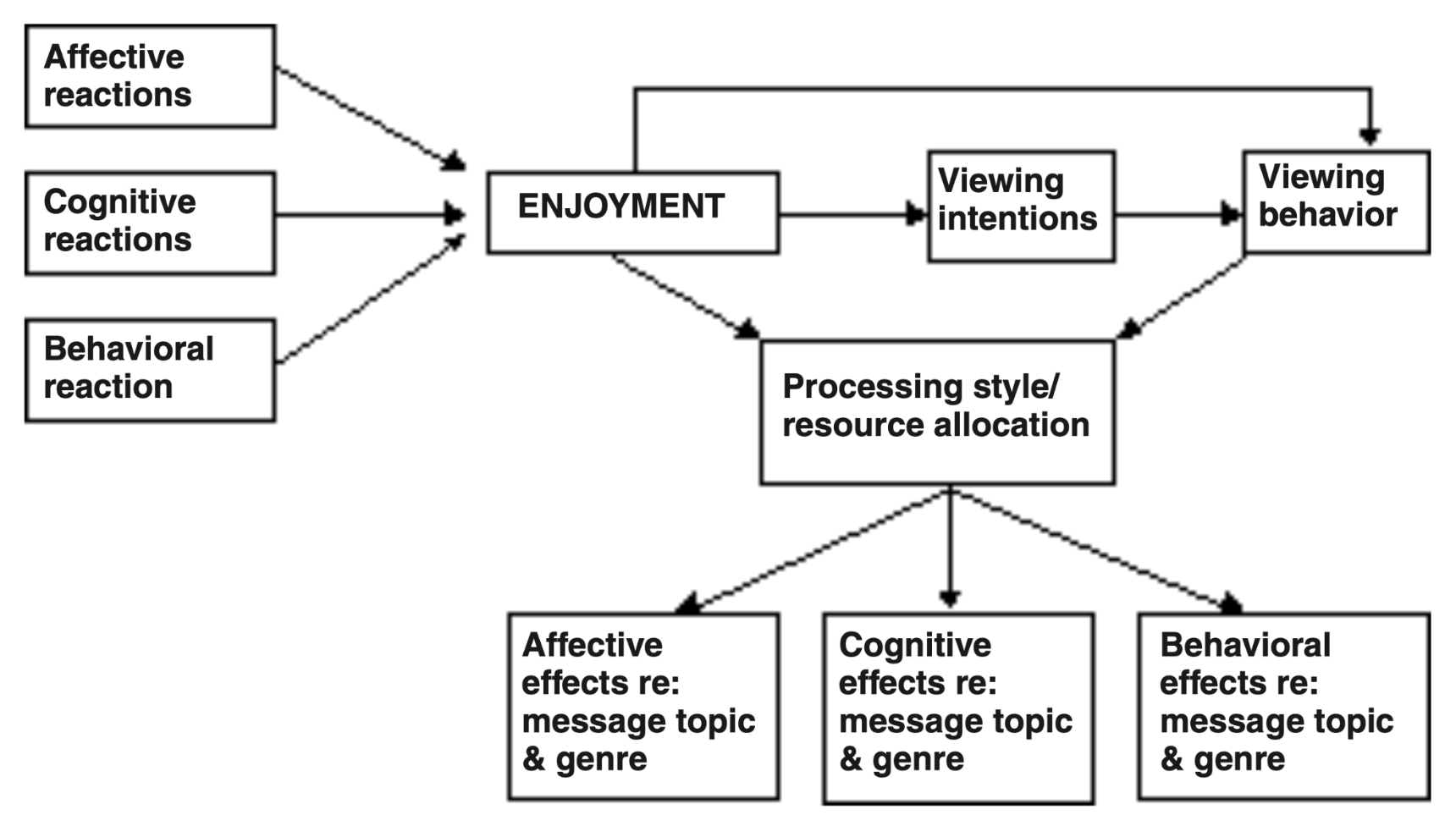
To address this complexity, Nabi and Krcmar [2] propose a tripartite perspective, which conceptualises media-enjoyment as the interaction of three dimensions:
Affective dimension
Cognitive dimension
Behavioral dimension
The affective dimension refers to the immediate emotions during the reception of a film. These include the emotional response to specific characters and empathy to the situation that they are in, which may evoke feelings such as fear, suspense or joy. These affective states can oscillate significantly during the reception, such as from one scene to another, making them valuable to model the experiential aspect of media enjoyment during the immediate reception in real-time. The understanding of this affective aspect of media-enjoyment has been largely shaped by the work of Dolf Zillmann, such as his affective disposition [3] and excitation transfer [4] theories.
The cognitive dimension concerns the intellectual judgement of a film, for example about its characters and their actions, the narrative structure and the production quality itself. Unlike the affective dimension, cognitive evaluations can still evolve long after the immediate reception of the film piece has concluded. Although affective and cognitive responses typically align and interact, it is not unlikely that they can be diametrically opposed. It is therefore possible to “like” or appreciate a movie without enjoying the process of watching it, as might be the case with some avant-garde productions.
The behavioural dimension has received the least attention in media reception research. Nabir and Krcmer distinguish three different forms of behaviour, which are
past or ongoing viewing experience,
past behaviours related to the message’s content
behavioural intentions regarding the content held by the viewer
behaviours during viewing.
For example, a viewer who enjoyed the first two Lord of the Rings movies (1) might also enjoy the final entry in the trilogy – especially if they are also an avid fan of fantasy role-playing games in their free time (2). If it matches their expectations (3)). However, the viewing experience might be hampered if the viewer is distracted by their smartphone during the film (4). This dimension also includes parasocial relationships to actors or other filmmakers.
This figure demonstrates that the three dimensions of affective, cognitive and behavioural reaction are not entirely separable, but rather inform each other during the process of media-enjoyment [2:297].
As stated above, the affective dimension typically dominates this immediate reception. After the reception has concluded, the experiential and fluctuating form of enjoyment gradually consolidates into a fixed attitude towards the film, largely shaped by a cognitive judgement.
Study Design Implications
Returning to the topic of Neurometrics, Autonomic Nervous System Indicators such as GSR are particularly well-suited for measuring the subconscious physiological responses associated with affective reactions during media reception. This has several implications for the design of studies utilizing GSR in the context of the three dimensions of media enjoyment:
GSR-measurements are most effective for films that follow a conventional, rising narrative arc, such as the three-act structure, which reliably create a strong affective response [5].
GSR-measurements should be complemented with posttest questionnaires or questionnaires to evaluate the cognitive dimension, which cannot be captured using GSR or other Neurometrics alone [6].
The study design should account for the impact of the behavioural dimension as well. Variations in behaviour during the viewing can be minimised by providing neutral test environments. [7]
These points highlight that an awareness of the limitations of GSR and other neurometric methods is essential for designing effective studies and for using their results in a meaningful way. Among the three dimensions of media enjoyment, GSR is most directly linked to the affective dimension, since it captures fluctuations in emotional excitation or arousal, which form the focus of the following discussion.
Affective Dimension
As described above, GSR is an indicator of emotional excitation, often also described as arousal. In their classic 1962 adrenaline study [8], Schachter and Singer proposed that physiological excitation is relatively undifferentiated and gains emotional meaning through cognitive interpretation of situational cues, i.e. excitation triggers. While contemporary research no longer supports a fixed sequence in which excitation precedes cognition and emotion, physiological excitation is still considered a reliable indicator of general heightened emotional states. Modest patterns in autonomic responses have been identified recently (e.g., cardiovascular changes differ partially across fear in comparison to anger). However, excitation measures such as GSR are best interpreted as indicators of general arousal or emotional intensity, rather than reliable markers of specific emotions [9].
One of the main topics of research in media reception studies has been the effect of media on aggression. In the 1960s, contradictory studies proposed that violent films could either increase aggression [10, 11] or reduce it in a cathartic effect [12, 13]. Zillmann’s excitation transfer theory represents an attempt to resolve the “catharsis–instigation controversy” [4]. His explanation for the contradictory research is that different states of arousal cannot be clearly separated from one another and may therefore overlap in time. If a stimulus triggers a lasting arousal, this “slowly decaying excitation” may be transferred to another state of excitation that has been elicited by an independent stimulus, as long as both are in temporal proximity. Excitation can thus be transferred even after a cognitive interpretation has been completed.
If a violent film scene is followed by a peaceful happy ending, the arousal triggered by the first scene adds to the relief over the happy ending—producing the (apparent) catharsis. If, however, the happy ending had not been preceded by other stimuli or scenes, the ending would be less satisfying for the audience. Reversing the example—if a joyful wedding is followed by a bloody assassination —an increase in aggression, by contrast, appears more plausible [4:423].
Although both of these theories – excitation not being an indicator for a specific emotion and excitation transferring between different stimuli and emotions – might seem to diminish the applicability of Neurometrics in evaluating media-enjoyment. Both statements actually allow for highly flexible study designs.:
Excitation-transfer helps to explain how stylistic and technical production elements have an impact on the emotion perception of a film – the excitation evoked by a sequence of rapid edits may transfer over into an emotional character scene. Excitation-transfer also implies that any part of the production could potentially have a significant impact on the enjoyment of the entire film.
Evaluating this impact using GSR can be either simple or very challenging, depending on the production element, with post-production elements being generally easier to test than pre-production and production elements. To test one production element, generally two versions of the same film or excerpt need to be created, in which the production element significantly differs. For example, testing an edit of a film requires creating an alternative edit. However, testing acting styles and actors is more complex, as it requires the entire reshoot of a scene and potentially additional post-production.
Cognitive Dimension
GSR-measurements and other Neurometrics are very effective at capturing the immediate physiological response during viewing, but they cannot assess long-term cognitive judgements, such as retrospective evaluation. To address the cognitive dimension of media-enjoyment, researchers often employ a post-experimental, standardized questionnaire to fill in the gaps [14].
The design of a questionnaire is largely dependent on the specific study question and requires the careful conceptualization of psychometric scales. A scale is the sum of responses to several scale-items on one specific topic. The most widely used scale is the Likert scale, a Likert item could be for example:
The movie is fun:
Strongly disagree
Disagree
Neither agree nor disagree
Agree
Strongly agree
The Likert item is a positive or negative statement (“The movie is fun”), which the study participant is asked to reflect on using a five-level range from “Strongly disagree” to “Strongly agree”.
Unlike subconscious Neurometrics, questionnaires are often not answered completely truthfully by participants due to inherent biases which most people share. While the Likert item above offers a neutral answer, depending on the study it might be beneficial to avoid a potential centrality bias by using a force choice method instead, which only allows for positive and negative answers. Other common biases are the social desirability bias, the tendency to select socially desirable answers, and the agreement bias, the tendency to select positive answers [15].
One way to combat biases is to rely on existing tried-and-true scales from other studies, which also allows the study results to be easily compared. In addition to researching existing studies on your own, scale handbooks collect proven professional scales in a more accessible format. In the context of film production, scales from marketing research are particularly useful, as they often focus on the reception of audiovisual material. For example, Gordon Bruner’s Marketing Scales Handbooks have collected English-language scales between 1992 and 2025 [16].
Behavioral Dimension
Applying Neurometrics to film production introduces additional requirements for the testing environment and experimental conditions to ensure that behavioural differences between the study participants influence the study results as little as possible. For an audiovisual medium such as film, the accurate presentation of moving images and sound becomes critical. Both the visual display and the acoustic setup must meet professional standards while minimizing external stimuli to ensure that audience responses are shaped solely by the filmic content.
For visual fidelity, test environments should emulate the conditions of a high-end colour grading studio: neutral wall colours (e.g., middle gray), fixed D65 lighting and calibrated displays, matte surfaces to avoid reflections, and ergonomic seating to maintain comfort over extended sessions. Similarly, the audio setup should draw from sound design studio practices, including proper acoustic treatment, isolation from external noise, and controlled reverberation.
In addition, participant demographics should be carefully considered: either as a diverse sample to reduce biases from past behaviours and viewing intentions, or as a homogenous sample to control for these variables. The correct approach to sampling is largely reliant on the study question, although it is often unrealistic to create an ideal sample. In such cases, it is important to acknowledge those potential sampling limitations during the analysis of the study results.
Equally essential are the participants’ psychological conditions before and during the study. To produce comparable data, participants need to reach a normalized psychological state before testing begins. Introducing a brief “dummy” film before the actual experiment can help participants acclimate to the sensors on their body and the laboratory setting, reducing novelty effects and stabilizing their baseline excitation.
Conclusion
Understanding media enjoyment through affective, cognitive, and behavioural dimensions shows both the potential and the limits of neurometrics in film production. GSR offers valuable insight into emotional arousal during viewing, but only in combination with questionnaires, behavioural controls, and careful study design can it produce results that meaningfully inform creative choices.
References
[1] Zillmann D, Hay TA, Bryant J. The effect of suspense and its resolution on the appreciation of dramatic presentations. J Res Pers. 1975;9(4):307-23.
[1] Nabi RL, Krcmar M. Conceptualizing media enjoyment as attitude: implications for mass media effects research. Commun Theory. 2004;14(4):288-310.
[3] Zillmann D, Cantor JR. Affective responses to the emotions of a protagonist. J Exp Soc Psychol. 1977;13(2):155-65.
[4] Zillmann D. Excitation transfer in communication-mediated aggressive behavior. J Exp Soc Psychol. 1971;7(4):419-34. doi:10.1016/0022-1031(71)90075-8
[5] Canini L, Ganovelli F, Scopigno R. Users’ response to affective film content: A narrative perspective. In: Proceedings of the 14th ACM international conference on Multimedia. New York: ACM; 2006. p. 385-94.
[6] Koch T, Peter C, Müller P. Das Experiment in der Kommunikations- und Medienwissenschaft: Grundlagen, Durchführung und Auswertung experimenteller Forschung. Wiesbaden: Springer VS; 2019.
[7] Kaltwasser L, Rost N, Ardizzi M, Schilbach L. Sharing the filmic experience: the physiology of socio-emotional processes in the cinema. PLoS ONE. 2019;14(10):e0223259.
[8] Schachter S, Singer JE. Cognitive, social, and physiological determinants of emotional state. Psychol Rev. 1962;69(5):379-99.
[9] Kreibig SD. Autonomic nervous system activity in emotion: a review. Biol Psychol. 2010;84(3):394-421.
[10] Berkowitz L, Corwin R, Heironimus M. Film violence and subsequent aggressive tendencies. Public Opin Q. 1963;27(2):217.
[11] Berkowitz L, Geen RG. Stimulus qualities of the target of aggression: a further study. J Pers Soc Psychol. 1967;5(3):364-8.
[12] Feshbach S. The stimulating effects of a vicarious aggressive activity. J Abnorm Soc Psychol. 1961;63(2):381-5.
[13] Feshbach S. The function of aggression and the regulation of aggressive drive. Psychol Rev. 1964;71(4):257-72.
[14] Mauss IB, Robinson MD. Measures of emotion: a review. Cognition Emotion. 2009;23(2):209-37.
[15] Sauro J. Rating scales in UX research: Likert or semantic differential? Nielsen Norman Group. 2019 Sep 29. Available from: https://www.nngroup.com/articles/rating-scales/. Accessed 30 Sep 2025.
[16] Southern Illinois University, Office of Scale Research. Marketing Scales Handbooks. Available from . Accessed 30 Sep 2025.