Interview INTERCONNECTION
The following interview with INTERCONNECTION director Marco Braune, complemented by comments from study conductor Aljoŝa Dakić, links the theoretical framework and data analysis of the case study with perspectives from those directly involved in the production and research. Lena Gieseke led the interview.
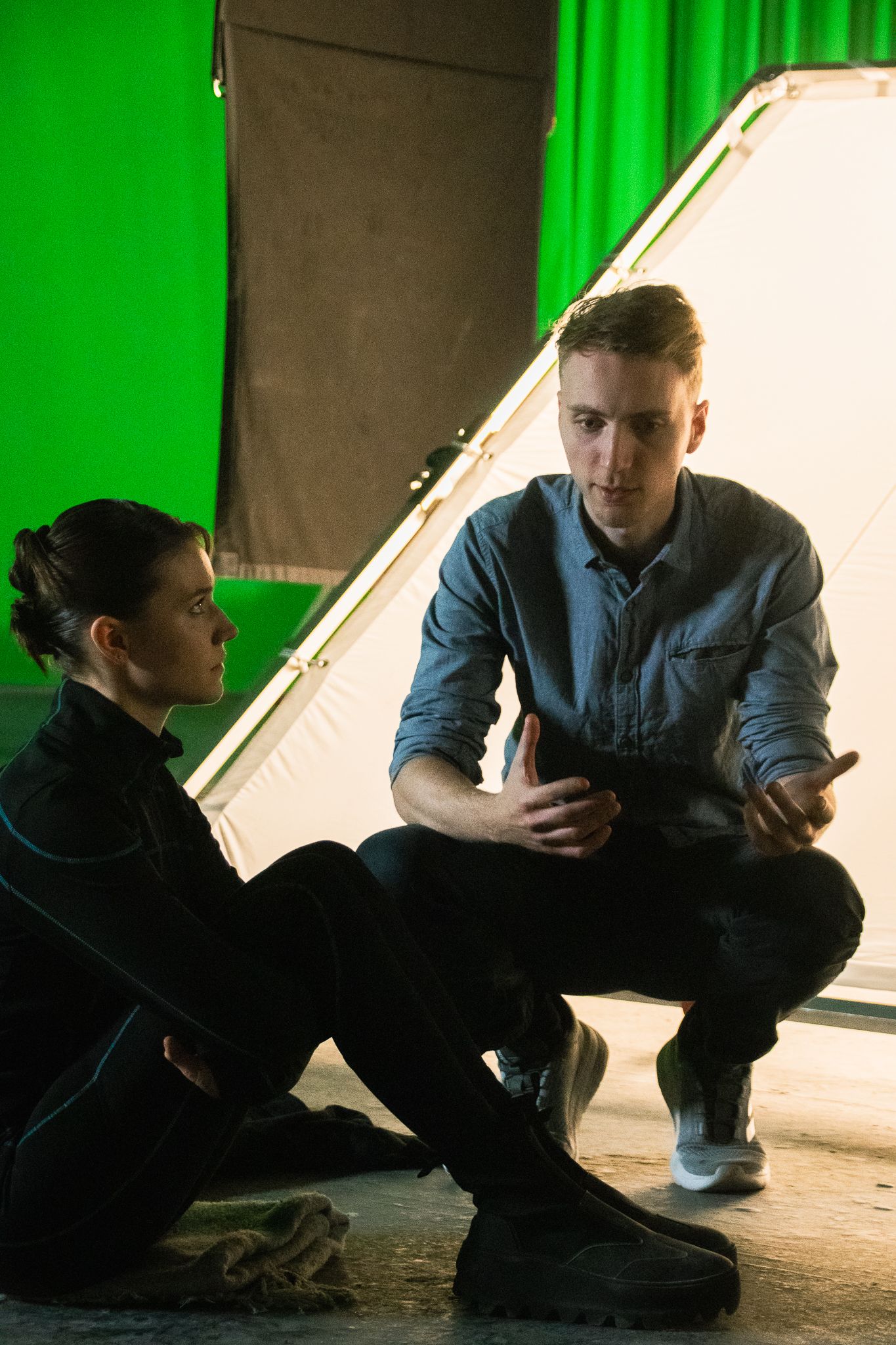
Director Marco Braune on set of INTERCONNECTION talking to the main protagonist.
The interview illustrates how creative intentions and production constraints can intersect with neurometric methods, and how physiological data may be interpreted with qualitative feedback. It further demonstrates the potential of such approaches to inform postproduction decisions, while also highlighting the challenges of handling biometric results responsibly. More broadly, the exchange shows the importance of iterative testing, critical reflection, and openness to new tools in contemporary film practice.
Q: How would you quantify your directing experience?
Marco Braune: I began working more professionally when I started my studies at Film University in 2021. Before that, I had done some smaller projects, but at Filmuni I was able to deepen and expand these activities.
Q: Do you have any main focus on specific genre?
Marco Braune: My main focus is on science fiction. I enjoy experimenting with other genres from time to time, but sci-fi remains at the center of my work.
Q: Briefly introduce yourself, your roles, your interests, your activities regarding film?
Marco Braune: In my Bachelor’s in Media Technology, I mainly focused on programming and building a solid technical foundation. Still, I always wanted to do something visual. It started with creating websites, which I enjoyed because programming turned directly into something you could see. Later, in my MA in Creative Technologies, I shifted more toward creative topics. At Film University, I was introduced to virtual production methods such as LED walls. For example, I took part in the Virtual Production Lab organized by the Film University and the Erich Pommer Institute in 2022.
Q: What draws you to filmmaking, to being a director?
Marco Braune: My motivation as a filmmaker is to explore stories beyond everyday reality. For me, it’s refreshing to step outside what is familiar, to create stories that offer a break from reality where audiences have the chance to lose themselves in something different. Of course, the themes are always shaped by what’s happening in the world, but I prefer to address those influences indirectly rather than literally. That interplay between present issues and imagined realities is what inspires me. It’s also the reason I watch films myself: sometimes I simply want to escape.
Q: Please describe Interconnection, a project we are going to refer to in this interview, and also describe your role within that project.
Marco Braune: Interconnection is a virtual-production sci-fi mini-series with five episodes, each running six to ten minutes. Together, they add up to about 40 minutes. The goal was to explore and demonstrate that LED walls can serve as more than a simple backdrop. Most productions use LED walls primarily to display CGI behind live-action scenes, which already offers advantages over green screens, such as capturing natural reflections and refractions. However, I wanted to explore whether LED walls could also serve as a creative or narrative device.
Since most LED walls run on Unreal Engine, which is a game engine, I was curious to push its interactive potential further. We began experimenting with ways to interact with the wall during production, treating it as a second narrative layer. For example, visual elements on the wall were no longer static backgrounds but became active parts of the story world, deepening immersion for both actors and crew.
I served as director, showrunner, and creator. The story originated with me, and I then collaborated with scriptwriters and producers to bring it to life.
Q: Where are you currently with the production and what is the outlook?
Marco Braune: Currently, the project is at a soft lock, meaning the edit is almost finalized but still flexible. The reason is that many scenes involve complex visual effects, including several that are entirely computer-generated, and these are still in the development stage. Because we want room for creative exploration in the VFX sequences, we are deliberately keeping the edit open. For example, we are still fine-tuning the timing and length of placeholder shots to ensure that the final visual effects will integrate seamlessly into the narrative rhythm. This provisional stage is what we refer to as a soft lock: the film's structure is stable, but details may shift as the effects evolve. Once the VFX are in place, we can proceed with building the sound design, which heavily depends on the timing and atmosphere of the final visuals.
Q: What do you understand as Neurometrics and the use of biometric data?
Marco Braune: For me, it’s an additional way of gathering information. It offers another layer for evaluating how people respond, for example, during test screenings, which is the context I imagine using it in.
Q: Do you have any experience with that?
Marco Braune: No.
Q: Which potential do you see in using neurometrics during film production to support creative decision-making?
Marco Braune: I think the main value is in understanding the emotions of the viewers and checking whether what we aimed for as filmmakers actually comes across. Emotional responses are hard to capture through questions alone. You can always ask if the story was clear or if the editing worked, but it’s much harder to ask what someone felt while watching. Feelings also shift once the whole film is over and you can’t reliably go back and ask what they experienced in the very first minute, because later impressions influence their memory. Neurometrics can help capture what the audience feels in the moment, sometimes even before they’re even aware of it themselves, which is where I see the real potential of this technique.
Q: Could you imagine and describe a concrete application scenario for Neurometrics within film production?
Marco Braune: For me, the clearest use case would be in test screenings. Test screenings are when we show the current state of the edit to an audience. At this stage, the film often still has placeholders, no finished sound design, and only temporary, or sometimes, no music. It’s essentially the first version we feel is close enough to share. The goal is to test whether the story is clear: does everything make sense, or do we need to add, remove, or re-edit scenes so that the film comes together in the end?
We’ve already held small test screening sessions with our own team, followed by open discussions, and later invited people unfamiliar with the project to complete questionnaires. The next step, I imagine, is to combine this process with neurometrics: viewers would still fill out questionnaires afterward, but during the screening, they would also be connected to biometric sensors. This way, we could capture both their conscious reflections and their subconscious, real-time responses.
Q: Is that the stage where, potentially costly, re-shoots would be decided on?
Marco Braune: Exactly. In our case, re-shoots weren’t really an option, mostly because of budget limitations. But in general, yes—that’s the point where you might realize a scene isn’t working as intended and decide whether a re-shoot is necessary.
Q: How do you question the audience after a screening?
Marco Braune: We tried two different approaches. In the first test screening, it was just our team, we watched an episode together and sometimes even paused in the middle to discuss our thoughts openly. In the second round, with new viewers, we screened the whole series in one go and then handed out questionnaires via Google Forms. After giving people time to answer, we opened a group discussion. Not everyone wanted to speak up, so having also written responses was very helpful for later evaluation. At the same time, the open discussion allowed participants to expand on their answers or raise new points, and for us to clarify the responses given.
Q: Do you see any barriers to using Neurometrics in film production?
Marco Braune: Not major ones, but there are a few things to consider. It does require more effort. Viewers need to set aside extra time for setup and be willing to use the devices. And being measured can influence behavior. Just as people act differently when they know they’re being filmed, they might also feel differently if they know their emotions are being tracked. That awareness could change their responses, which is something to keep in mind.
Q: Do you see any other potential negative aspects, for example, ethical, artistic, or in terms of teamwork and communication?
Marco Braune: As long as everyone agrees to be measured, I don’t see major issues. The important part is how we interpret the data. You can’t simply take every result at face value. For example, if one person shows negative emotions or writes in a questionnaire that they didn’t understand anything, it doesn’t mean the film failed as a whole. The data needs to be discussed, contextualized, and balanced against other feedback. While I don’t see a fundamental negative aspect, I do think the real challenge lies in handling the results responsibly.
Q: How do you suggest responding to potential barriers or negative aspects?
Marco Braune: As long as a human makes the final decisions, I see additional data as beneficial. The main risk as filmmaker is getting overwhelmed by the amount of information and losing sight of the creative process. If the data is used to support decisions, it can be invaluable. But if it is collected only to let an AI make the edits, then the creative process is undermined. For me, the value lies in treating neurometrics as an extra layer of insight, not as a replacement for human judgment.
Q: Do you have any visions for using neurometrics beyond what is currently possible, or any dystopian scenarios?
Marco Braune: It is hard to predict, but I imagine that everyday devices could play a role in the future. Smartphones and smartwatches are already collecting data such as eye tracking or heart rate, and they could also measure things like skin response. If that happens, neurometric data could be gathered not only in controlled screenings but also after a film is released, while people are watching it on a train or at home. That information could even extend beyond film to other media such as music or games. Of course, this also raises dystopian questions about how much data should be collected, who controls it, and what it is used for.
Going back to the negative example of feeding the data directly into an AI system, there might be a useful middle ground. Instead of letting an AI edit a film entirely on its own, aggregated human emotional responses could be used to guide AI-assisted editing. There are already tools that automatically trim and assemble footage. I have not worked with them in depth, but using real audience data to steer these tools might be a better option than full automation. It would keep human judgment in the loop while still taking advantage of automation, although it is far from an ideal substitute for creative decision making.
Q: What support or learning materials would you recommend for starting to use neurometrics in production?
Marco Braune: First, it is essential to build a basic understanding of the hardware and how to connect it to the software, meaning the technical setup has to be in place. But just as important are reliable workflows for evaluating the data. You need guidance on how to interpret the signals you collect. Otherwise, the measurements will not be meaningful for the creative process.
Aljoŝa Dakić: In the middle part of the film, the data showed a more monotonous phase where little new information was introduced and there were no significant emotional arousals. This does not mean the sequence was bad or boring, it simply reflects the absence of the strong physiological reactions that usually occur during big action moments, horror scenes, or other high-intensity visuals. Such strong reactions are not typical in quieter, dialogue-driven drama. At the beginning, we did see the expected spikes linked to action. Toward the end, there were smaller peaks of arousal, which most likely came from the growing interaction between the two characters and the audience’s increasing involvement with them. That would be the rough interpretation of the data.
Q: What is your response to the graphs?
Marco Braune: I think they provide a great overview, although it takes a moment to process all the information. It is interesting to see the results. For example, when the two characters first appear together, I would have expected a stronger emotional reaction, but the data makes it clear why that was not the case.
Aljoŝa Dakić: In this sequence, many participants focused strongly on the lighting, which is interesting from a virtual production perspective since your project is entirely built in that environment. One participant, for example, reacted very intensely to a lighting change.
Two people in the group had actually visited the film set during production. For one of them, the data shows a strong reaction at a moment they personally remembered from being on set. That connection, linking the viewing experience to a personal memory, highlights how much context outside the screen can influence what we feel while watching.
Another participant, an actress, showed her highest peaks at the final scene, during the interaction between the two main characters. She also gave detailed comments, both positive and critical, about the performance of the actress and about the chase sequence. In the beginning, she said she was mostly trying to figure out what was happening in the story. But once the interaction started, her responses became very engaged: she noted what worked, what could have been done differently, and reflected on the acting process itself. For me, this was fascinating because it showed how personally and critically viewers can engage, and how much depth lies behind the physiological data.
Q: What in the data is meaningful? Was anything surprising?
Marco Braune: Yes, I think the data is meaningful because it reflects the intended flow of the episode. Our goal was to start with a strong, emotionally charged opening that would capture the viewer’s attention and then gradually lead them into the story. The data clearly show this pattern, which is reassuring. What surprised me was the lack of a stronger response when the two characters first meet. I expected a peak there, but it did not appear in the viewers’ physiological reactions.
For me, the real value is also in using this data to guide creative decisions, especially in sound design and music. I already had ideas about where to use themes and atmospheres, but the measurements could help identify sections where additional sound elements might strengthen engagement. We could then run another test without changing the edit, only adjusting the music, to see if it produces the emotional response we are aiming for. That is where I see a lot of potential.
Q: Do you have any recommendations for how the actual study setup could be improved?
Marco Braune: I think the key is to have more study iterations. It would be useful to conduct one test early on, then make changes both visually and in terms of sound, and run another test afterward. With only one screening, it is difficult to know when the method is most valuable. If you wait until everything is finished, you might get the clearest responses, but at that point nothing can be changed. The best approach is to test multiple times throughout the process so that the feedback can actually influence the creative decisions.
Aljoŝa Dakić: I think it could make sense to not only invite more participants but also to form different groups. For example, once we are confident that the story works, we could invite people with a background or interest in VFX to focus specifically on the effects we added. Their perspective might be quite different from that of a general audience. Comparing feedback from different groups could be more insightful than putting everyone together in a single test.
Q: Is there anything else you would like to add or emphasize before we close the interview?
A: At this point, I am mainly interested in how the study will continue and whether there will be another iteration with this project. The edit has already changed, and I think it would be very valuable to test it again after we add more elements.
INTERCONNECTION is set to be published in spring 2026!